Search intent: Tom Cruise Height 1.70m

Google takes your search term and works hard to discover the underlying intent behind the search. Bringing to bear the vast historic and current search landscape as well as trending queries, your search term is interpreted very early on in the decision process. The results ‘most likely to match your intent’ are then presented in SERPs.

This is not really news to the SEO community, but we often choose to ‘skip over’ the deeper implications and what this means to how we optimise sites and advise our clients.

In a recent interview with Emily Moxley, an example was given for how a short tail search term was augmented in order to ensure the ‘most likely’ search intent was represented in the results:

http://www.7×7.com/tech-gadgets/google-s-emily-moxley-knowledge-graph-and-women-tech

Emily explains that searches for ‘Tom Cruise’ often include a reference to Tom’s height. Google decides that all searches for ‘Tom Cruise’ are likely to be related to Tom’s height, so should therefore include results that confirm Tom Cruises height is 1.70m – even though the original search didn’t include the height request. Google knows that in the majority of cases, anyone looking for Tom Cruise wants to know how tall he his.

Therefore, Universal SERPs are made up of variety of ‘best guesses’ at the meaning or intent behind the search. The results are not simply a mix of news, videos and images related to the query term. The results are a mix carefully selected to match the search intent behind the term.

Try the search intent tool to gain a more complete understanding of the intention of the searcher in Google.

For example, a search at the time of writing for the term ‘sandy’ will produce a page of results relating to the hurricane Sandy. It is assumed that the intent behind the query is to discover the latest news on the hurricane rather than the definition of the word ‘sandy’ or a search about beaches.
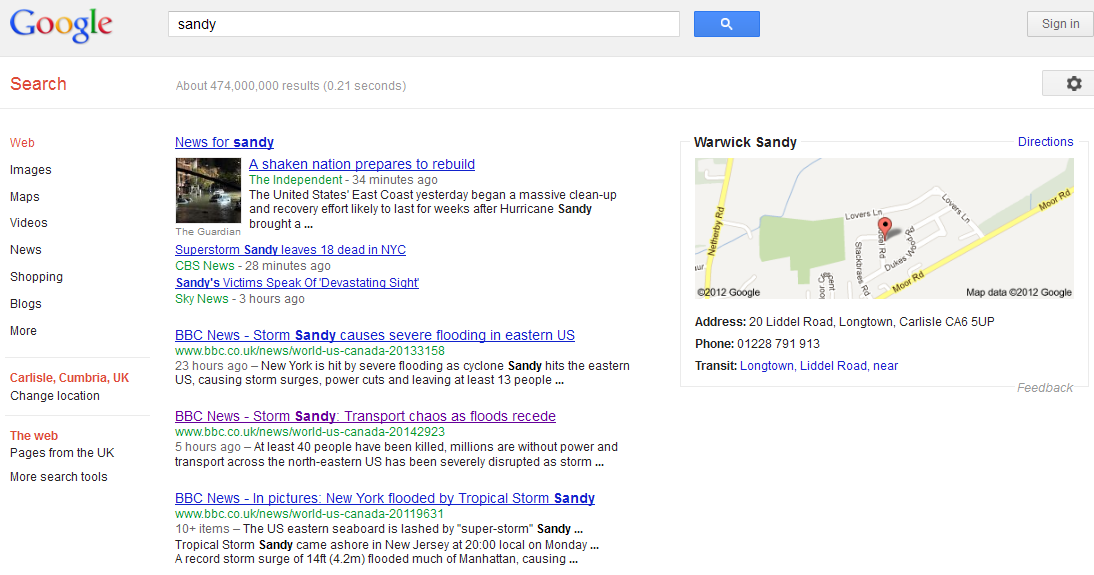
Sandy search from Carlisle

Notice that the knowledge graph result is for a local businessman ‘Warwick Sandy’, living in Longtown, Carlisle.

The same search from Inverness produces a Google+ page for a local photographer called Fea Sandy as well as the hurricane related results:
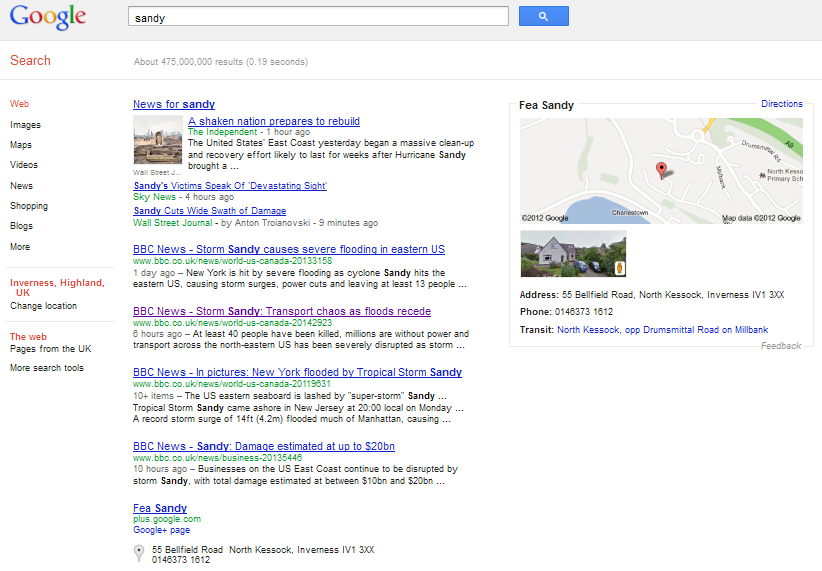
Sandy search from Inverness

The same search ‘sandy’ from London produces a different map and a different set of results (including the Guardian in second place):
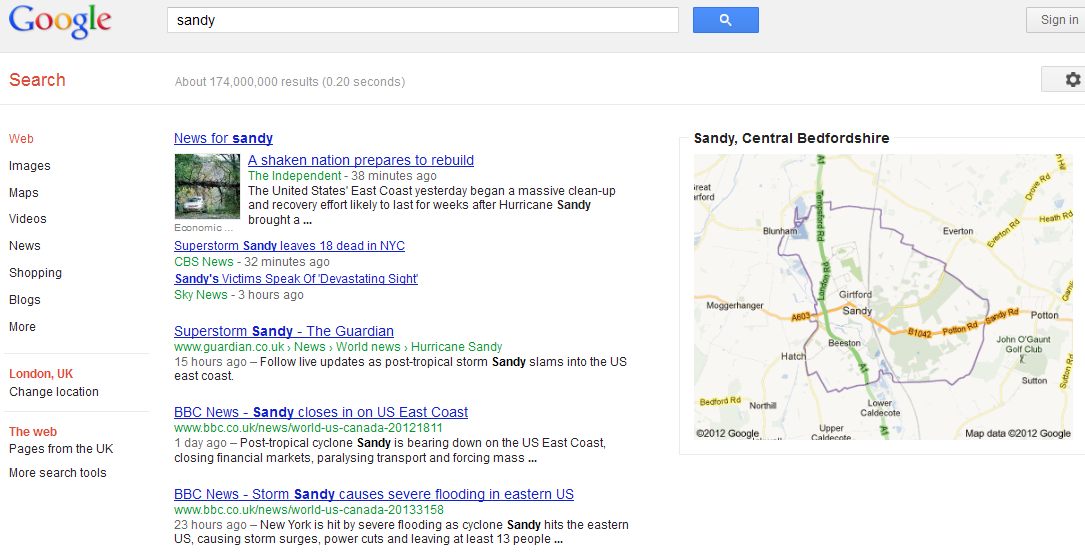
Sandy search from London

If the location is changed to ‘Bedford’, then the search results for the term ‘sandy’ include the wiki entry for Sandy the small town in Bedfordshire:
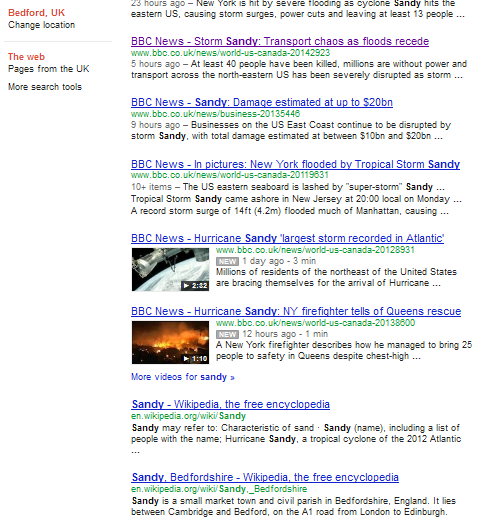
Sandy search from Bedfordshire

It is clear that the intent behind the query is determined from multiple sources:

  • Trending and historic search terms related to query e.g. sandy storm, sandy hurricane, tom cruise height
  • Search location to produce relevant results e.g. Local business, or local information
  • Previous queries and sites visited ie. search history

Typically, Google ensures that results include associated terms when the original intent is not clear.

More than ever before, it is important to understand the intent behind queries, then ensure your site content satisfies that intent. Google will prefer to show sites that best match the intent behind the query, not simply match the query to the title or on-page content. Matching keywords to content isn’t enough anymore.

Matching the intent behind the query to on-site content is more likely to produce results as Google gets better at determining what the query actually means rather than simply matching the key words themselves.

So if you are trying to rank well for ‘Tom Cruise’ then be sure you mention his height…


Enhanced by Zemanta

Google disavow tool for links released

At last, Google has released a disavow links tool. This will really help to clean up years of linkbuilding abuse that gave businesses unfair ranking advantages or a while, until Google Penguin was released.

The disavow tool is available at:

http://www.google.com/webmasters/tools/disavow-links-main

and the news of the release can be found here:

http://googlewebmastercentral.blogspot.co.uk/2012/10/a-new-tool-to-disavow-links.html

Google disavow links tool

When selecting the ‘Disavow links’ option, you are given a warning page:

Disavow links warning

Proceeding with the option, and with trepidation ignoring this warning from Google that it is an advanced feature, we get an upload lightbox:

Upload disavow links file

Couldn’t resist an image test on the way 😉

Upload disavowed links in google


The text file must be smaller than 2Mb with one URL per line. Comments can be included in the file if prefixed with a #.

# Sitewide links impossible to remove
domain:blognetwork.com
# Links still remain on these pages
http://www.mostlyspam.com/links.html
http://www.mostlyspam.com/featuredadverts.html


Where “domain:” tells Google to disavow links from all pages on a the “blognetwork.com” site.
Specific pages can be disavowed by listing the complete URLs.

Only one disavow file per site is allowed and it is shared among site owners in Webmaster Tools.

If you want to update the disavow file, you must download the existing disavow file, modify it, and re-upload it.

Don’t expect overnight results, Google suggests that it may take up to 2 weeks for the submitted URLs to be re-crawled before the disavowed links have any impact. Also, a manual reconsideration request may still be necessary, after allowing a period of time to pass following disavow links file upload.

So this tool may not fix everything, but at least it helps with backlink cleanup following the Penguin algorithm release and updates.

This is a major step forward in promoting best practice by Google and I hope the tool doesn’t break !

Semantic Relevance or Exact Match Domain Penalty ?

One of the tests intended for the freshwater frisbee article, posted just a few days ago, was to determine whether the page would be returned in SERPs for semantically relevant search terms. The test term for this page is a common 4 letter word beginning with ‘f’ and ending in ‘ish’. This word had been deliberately omitted from the page content and each natural occurrence was replaced with a dummy term ‘frisbee’.

The page was indexed successfully shortly after publication and is now duly returned for the following search query as shown in the screen shot below:

https://www.google.co.uk/#q=seoeditors+freshwater+carp&hl=en&nfpr=1

Freshwater Carp
Search Results for: SEOEditors freshwater carp

All six indexed pages relevant to this search are shown above. The first two results are from this site, as expected.

Notice that the search included an ‘exact match domain’ term: ‘seoeditors’

If we repeat this search, and add the semantically related term beginning with ‘f’ and ending in ‘ish’, then this site is not returned in the SERPs:

Freshwater Carp with semantically related term
Search results for: SEOEditors freshwater carp + ‘semantically related term’

Only three results this time…

Hang on, this means that the ‘freshwater frisbee’ page was the most relevant result before, but now that we’ve added one more search term to the query – and not just any old term – a semantically related term, the page isn’t returned in SERPs at all!

This might suggest that because we’ve included the word beginning with ‘f’ and ending in ‘ish’ to the search query, the page has now been deemed irrelevant to the query because it doesn’t contain the term in the content. The addition of just one additional term makes the page irrelevant, even though the page is by far the most relevant to all the other terms in the query: ‘seoeditors’,  ‘freshwater’ and  ‘carp’.

This suggests the following possibilities:

  • the keyword must be on the page
  • even if every other word in the query is on the page, the page will not be returned at all (let alone rank well) if just one key term in the query is absent
  • semantic relevance hasn’t been established for this test: despite talking about carp, tench and freshwater and linking to pages including words beginning with ‘f’ and ending in ‘ish’
  • an ‘exact match domain’ penalty may have been applied, but only when one of the search terms is absent from the page

This is just the first stage in a series of tests planned to investigate semantic relevance, however the recent exact match domain penalty has introduced a new dimension to the test.

Only one link (a no-follow link) has been built to the freshwater frisbee page from a semantically relevant page. The linking page mentions the word beginning with ‘f’ and ending in ‘ish’ frequently.

Perhaps one inbound semantically relevant link isn’t enough to associate the page with the term ?

Perhaps more links are needed before the test page will be returned for a query including the word starting with ‘f’ and ending in ‘ish’ ?


Enhanced by Zemanta